Curating Chinese Classical Furniture and Interior Furnishings in a Unity3D Virtual Museum: Prototype Design and Pilot Evaluation
Abstract
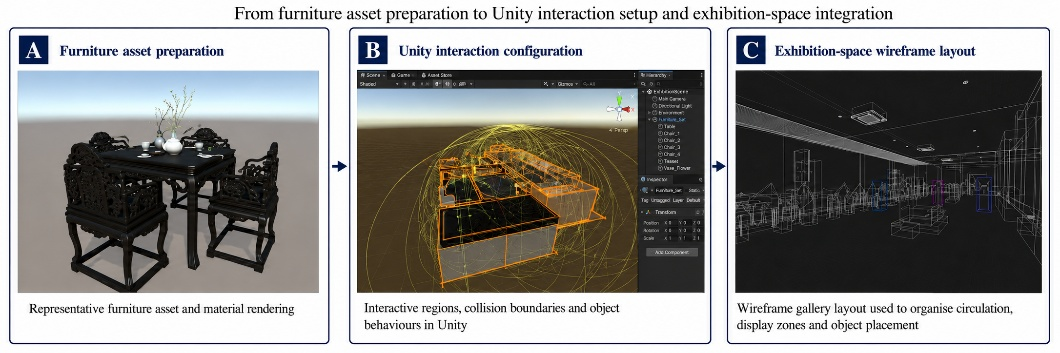
Traditional museum displays often restrict Chinese classical furniture to fixed viewing angles, making it difficult for visitors to understand its spatial placement, material detail and interactional qualities. This paper presents a practice-based study of a Unity3D virtual museum for Chinese classical furniture and interior furnishings. The study treats digitisation as curatorial translation rather than simple model transfer: furniture form, screen-based narrative imagery, spatial atmosphere, interpretive media and visitor action are reorganised into a digital museum encounter. The prototype integrates furniture category browsing, 360-degree rotation, zoomed inspection, audio/text interpretation, guided roaming, free roaming, VR viewing and video demonstration. Four forms of evidence are presented: a curatorial and system-composition diagram, production workflow, implementation screenshots and pilot visitor-evaluation results. A formative evaluation with 25 university participants examined six visitor tasks and six experience dimensions. Across 150 task attempts, 135 were completed, giving an overall task-completion rate of 90.0%. Visual clarity scored highest (M = 4.62, SD = 0.28), while immersion scored lowest (M = 3.71, SD = 0.59), and roaming was the least completed task (76%). The findings suggest that the prototype supports visual presentation and basic object inspection, but that spatial orientation, interpretive continuity and immersive comfort require further refinement.