Research on Integrated Conservation of Island Settlement Cultural Heritage in China: A Case Comparison from the Perspective of "People–Dwelling Environment"
Keywords:
Island settlement cultural heritage; Integrated conservation; People–Dwelling–Environment; Community co-governance; Wisdom of traditional dwellingsAbstract
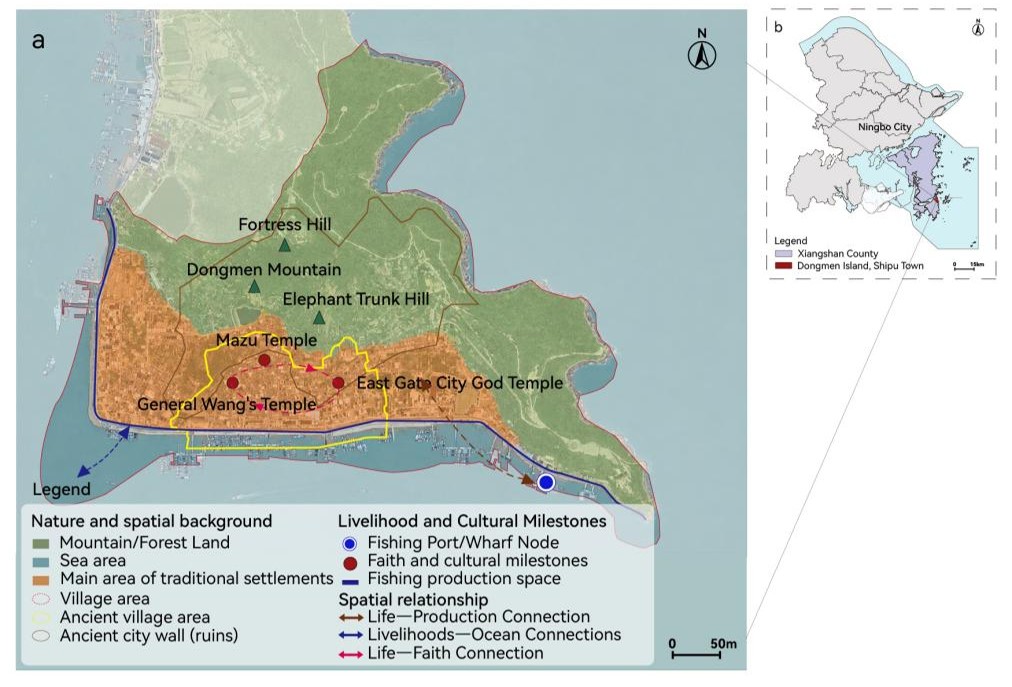
Island settlement cultural heritage is a regional human settlement system formed through long-term interaction among the marine environment, traditional livelihoods, and local society. Its value lies not only in traditional buildings themselves, but also in the integrated relationships formed among settlement space, production and lifestyle, local culture, and the natural environment. In response to issues such as population outflow, livelihood transformation, and the decline of settlement space, this paper selects Yim Tin Tsai Village in Hong Kong, China, and Dongmen Fishing Village in Ningbo, Zhejiang Province, as cases. Using literature analysis and case comparison methods, it compares cultural heritage conservation practices in the two places from the perspective of "People–Dwelling–Environment," and analyzes them in terms of participating subjects, spatial conservation, livelihood relations, and cultural transmission. The study shows that Yim Tin Tsai takes community participation as an important driving force and sustains its local cultural landscape through the coordinated conservation of traditional buildings, salt fields, and cultural spaces; Dongmen Fishing Village, based on the repair and renovation of traditional dwellings, combines fishing culture transmission to maintain the connections among dwellings, fishing ports, and local culture. Accordingly, this paper summarizes the integrated conservation pathways of value identification, cultural translation, spatial maintenance, and community co-governance, providing references for the conservation of island settlement heritage and the inheritance of traditional dwelling wisdom.