Digital Presentation of Cultural Relics and Gesture-Based Interactive Design: A Case Study of the "Five Stars Rise in the Eastand Benefit China" Brocade Armguard
Abstract
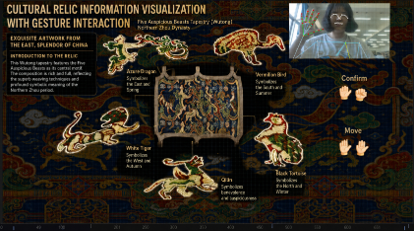
Against the backdrop of the continuing development of digital museum exhibitions, the presentation of cultural relics should no longer remain a simple superimposition of high-resolution images, three-dimensional models, and explanatory text. Addressing the complex hierarchy of artifact information, the high threshold for audience comprehension, and the tendency of interactive displays to become formalistic, this study takes the “Five Stars Rise in the East and Benefit China” brocade armguard as its research object. By integrating cultural relic information visualization, embodied cognition, and gesture-interaction design, it develops an interactive display prototype based on TouchDesigner and MediaPipe. The research proceeds from four aspects: artifact-information extraction, interaction-action mapping, visual-feedback mechanisms, and evaluation dimensions and problem correction. It proposes a design path of “overall viewing-local approach-knowledge comprehension-feedback correction.” The study argues that gesture-based interaction can serve as a method for information organization and viewing guidance in the digital exhibition of cultural relics. Through motion mapping and visual feedback, it helps audiences better understand patterns, texts, and other information, thereby enhancing the effectiveness of cultural heritage communication and utilization.