Beyond the Screen: Embodied Heritage Experience Design Based on Multimodal Interaction in Historical Districts—A Case Study of Lushun Taiyanggou
Abstract
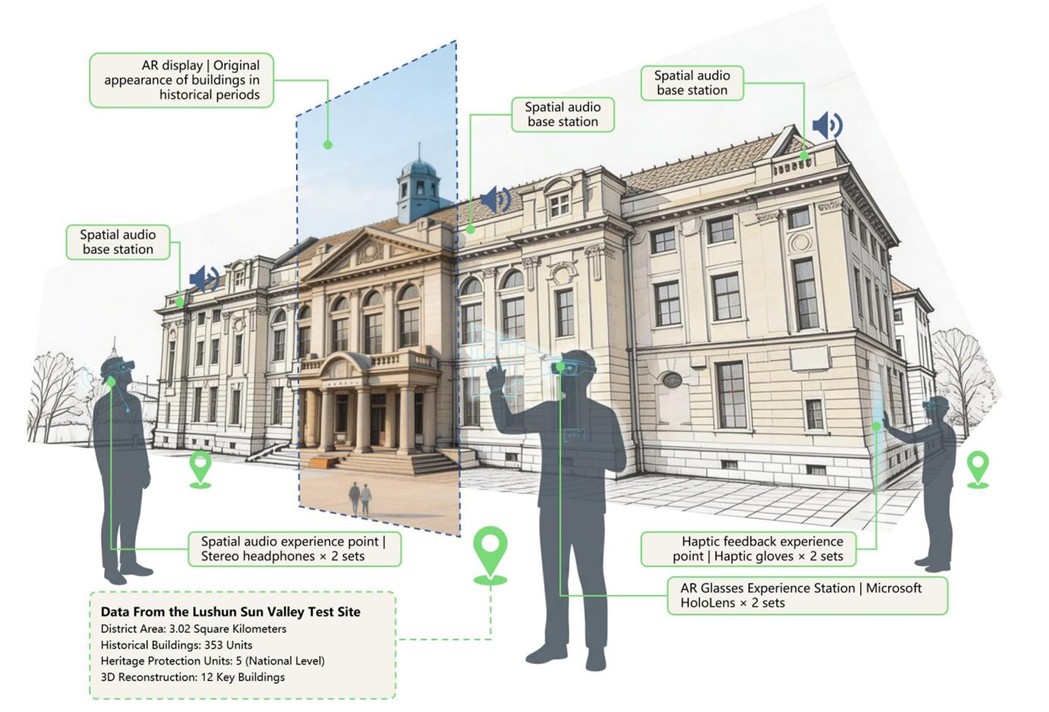
Current digital heritage experiences ubiquitous over-reliance on visual channels, leading to a disconnect between visitors' bodily perception and the deeper meanings of historical spaces. To address this issue, this study proposes and validates an "full-body engagement" interactive design framework (E-HEDF) that integrates AR vision, spatial audio, haptic feedback, and movement trajectories, based on embodied cognition theory. Using Lushun Taiyanggou historical district as an empirical scene, mixed research methods were employed to evaluate the experience effects. The findings reveal that: multimodal collaborative experiences significantly outperform single-visual experiences in depth of meaning construction; visual-auditory-tactile three-channel collaboration produces experience enhancement effects; generative AI-driven content adaptation effectively improves user engagement. This study provides actionable design guidelines for the digital preservation of historical districts.