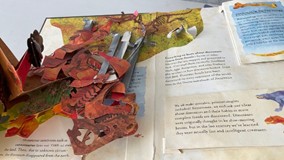
Comparative Study of Paper Materials for Tactile Pop-Up Books for Visually Impaired Children in Cultural Heritage Communication
Abstract
In the context of cultural heritage dissemination, visually impaired children face difficulties in accessing information through visual media. Using tactile pop-up books as a medium, the impact of paper materials on tactile reading experience is examined. By constructing substitute geometric models, four types of paper—high-white cardstock, standard cardstock, model cardstock, and cotton paper—are compared in terms of formability, durability, safety, and tactile quality. The results indicate a trade-off between structural performance and tactile experience: high-white cardstock shows the best overall performance; standard and model cardstock provide stable structures but limited tactile comfort; cotton paper offers better tactile comfort and safety but weaker formability. It is suggested that material selection or combination should be based on functional requirements to achieve a balance between structural integrity and tactile experience, providing references for accessible cultural heritage dissemination.