A Study on the Picture-Book Translation of Complex Village Spaces: The Case of Eya Village
Abstract
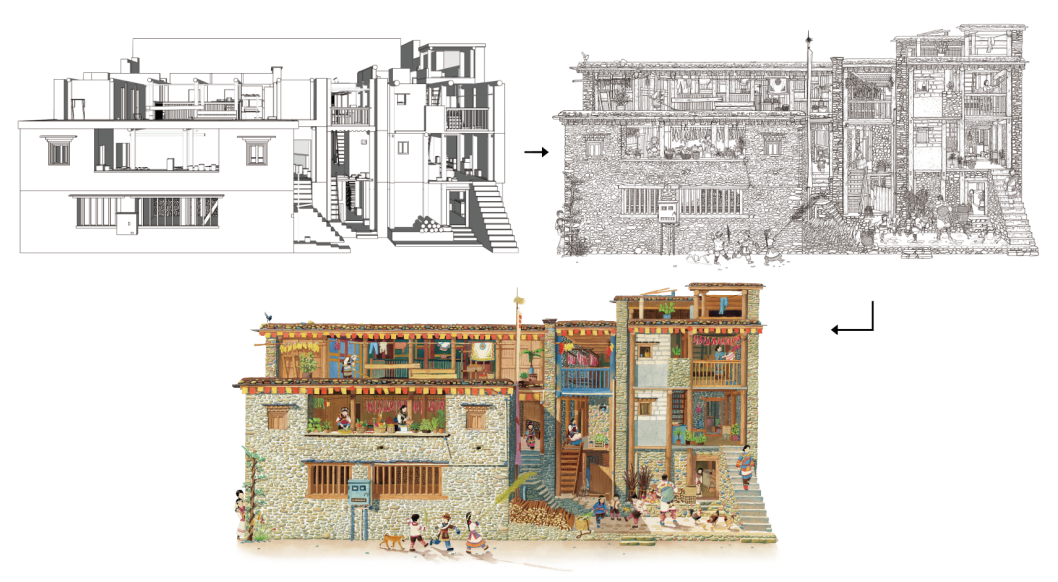
Picture books on traditional villages play an important role in children’s cultural communication. However, when the subject involves villages with complex spatial relations, picture-book creation often struggles to balance authenticity, readability, and visual organization because of the lack of stable spatial references. Taking Eya Village as a case study, this article explores methods for translating complex village spaces into picture-book images. Characterized by a honeycomb-like settlement pattern and vertically layered dwellings, Eya Village presents considerable challenges for spatial representation and therefore offers significant research value. To address this issue, the study selects three adjoining houses as core samples and establishes an analyzable, verifiable, and reusable spatial system through the combined use of field surveying, floor-plan drawing, three-dimensional modeling, and hand-drawn visual translation. This spatial system is then introduced into the process of image translation. The study summarizes this method as a technical pathway consisting of field surveying, hand-drawn floor plans, digital floor plans, three-dimensional modeling, spatial sectioning, hand-drawn translation, and final illustration rendering.